
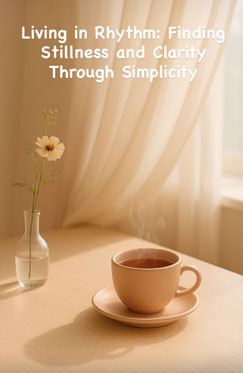
Many people long for rest, structure, and focus — but what they truly seek is rhythm. Rhythm isn’t a schedule or a plan; it’s a natural flow that moves with life itself. When you live in rhythm, a sense of direction arises on its own. You stop pushing and start listening. Rhythm is the pulse of your breath, the seasons, your heartbeat. It’s not something you design — it’s something you remember how to trust.
The difference between routine and rhythm
Routines come from the mind: what needs to be done, what’s efficient, how do I stay in control. Rhythm comes from presence: what is this moment asking of me, how does my energy feel right now, where is movement needed and where silence. When you begin to listen to your natural rhythm, your days start to shape themselves. Not because you plan them tightly, but because you’re inside them, fully present. Spiritual practice then becomes less about seeking meaning and more about allowing meaning to unfold. It’s a quiet form of coming home — to yourself and to life as it is.
The neurodiverse mind and rhythm
For a neurodiverse mind — for example with ADHD, autism, or high sensitivity — rhythm can feel complicated. Structure helps, but too much of it suffocates. This kind of mind moves in waves, not straight lines. It thinks associatively, flows with curiosity, and resists confinement. Rhythm then becomes freedom: structure without pressure, safety without control. When you learn to follow your own natural tempo, you realize that focus doesn’t need to be constant. Energy moves in cycles — moments of high clarity followed by rest or emptiness. When you stop fighting that movement, life becomes softer. Rhythm stops being a demand and becomes a gentle foundation that holds you steady.
Tinkering as a spiritual practice
There’s wisdom in what we call “tinkering” — doing things without a clear purpose or plan. In that unstructured play, the most authentic inspiration often appears. Tinkering isn’t laziness; it’s how intuition breathes. You let your hands lead instead of your head.
Especially in busy times, this gentle wandering becomes medicine. The small, ordinary acts — watering a plant, cooking a meal, folding laundry — become quiet rituals of reconnection. They bring you back into contact with life itself. It’s not about productivity, it’s about presence. In those simple moments, the soul exhales.
Living with simplicity and presence
Living in rhythm doesn’t require more discipline; it asks for more listening. Listening to your body, your breath, your home, your surroundings. Through simplicity, clarity naturally returns. When you give attention to the small things — the smell of coffee, the light through the window, the rhythm of footsteps — something inside begins to soften. Time expands. Simplicity isn’t emptiness; it’s nourishment. It’s where peace, creativity, and awareness meet. That’s where healing happens — not in doing more, but in being with what already is.
Exercise Living in rhythm and simplicity
This exercise helps you not just understand rhythm, but experience it. By slowing down and bringing attention to small daily actions, you invite natural calm and presence into your life.
Step 1
Choose one simple daily moment you usually do on autopilot — making tea or coffee, hanging laundry, walking, or washing dishes. See it not as a task but as a ritual.
Step 2
Do it slowly, with full awareness. Breathe gently, feel your body, observe the textures, sounds, and movements.
Step 3
Whenever your thoughts wander, bring them back softly to what’s happening now. Not by force, but by remembering: this moment is enough.
Step 4
When you’re done, stay for a moment. Feel your body, listen for any feeling or insight that surfaces. Write it down without analyzing.
Step 5
Repeat this for several days with the same action. It will slowly become a natural practice of presence and simplicity.
Reflection questions
-
Which moments in your day feel like natural rhythms?
-
How does your body respond when you slow down?
-
What changes in your mood when you allow simplicity?
-
When does slowing down feel uncomfortable, and what might that reveal?
-
How could you bring more rhythm into a busy or chaotic day?
-
Which daily actions make you feel most connected to life?
-
What does ‘simplicity’ mean to you right now?
Living in rhythm doesn’t demand big change — only a conscious choice to be present with what already is. When you treat the day as something that moves with you, not something you must control, a quiet sense of direction returns. Simplicity stops being small and becomes powerful: a way of staying connected to life itself.
And if you find it difficult to rediscover your natural rhythm, a reading can help you sense where the current has slowed and how it can begin to move again, softly and naturally.
Tags:
rhythm, simplicity, mindfulness, presence, spiritual growth, daily rituals, intuitive living, embodiment, neurodiversity, adhd, hsp, high sensitivity, calm mind, slow living, inner balance, self awareness, grounding, healing, intuitive practice, gentle exploration, creative play, self leadership, conscious living, nervous system regulation, soul connection, holistic healing, spiritual practice, flow, self care, awareness, trust, integration, emotional balance, stillness, peace, intentional living, alignment, personal growth, spirituality, self reflection
Write a comment